Blue Temple Chiang Rai Visitor Guide
Visiting the Blue Temple in Chiang Rai? Learn when to go, what makes it unique, and why many travelers find it more peaceful than the White Temple.
Last updated: July 1, 2026
Start with the free-entry and timing advice below, then choose a half-day vehicle or guided temple circuit.
Blue Temple Quick Facts
| Official Name | Wat Rong Suea Ten (วัดร่องเสือเต้น) – “Temple of the Dancing Tiger” |
| Location | Rim Kok subdistrict, 6 km north of Chiang Rai city center – 10-minute drive |
| Opening Hours | Daily 7:00am – 8:00pm (open later than the White Temple) |
| Entry Fee | Free. Donations accepted and appreciated. |
| Photography | Permitted inside and outside. Be respectful during prayers. |
| Dress Code | Shoulders and knees covered. Shoes removed to enter the hall. Sarongs available. |
| Best Arrival Time | 4:00-6:00pm for golden hour light. 7:00-9:00am for morning quiet. |
| Time to Budget | 45-60 minutes standard; up to 90 minutes if you explore fully |
| Designer | Phuttha Kabkaew (also known as Sala Nok), student of White Temple creator Chalermchai Kositpipat |
| Construction | Started October 2005; main hall completed January 2016. Still expanding. |
| Main Buddha | Phra Buddha Ratchamongkol Bodi Trilokanat – white porcelain, 6.5 m high, 5 m lap width |
| Crowd Level vs. White Temple | Significantly quieter. No tour bus convergence problem. |
Hours and entry confirmed May 7, 2026. Blue Temple remains free as of 2026.
What Is the Blue Temple in Chiang Rai?
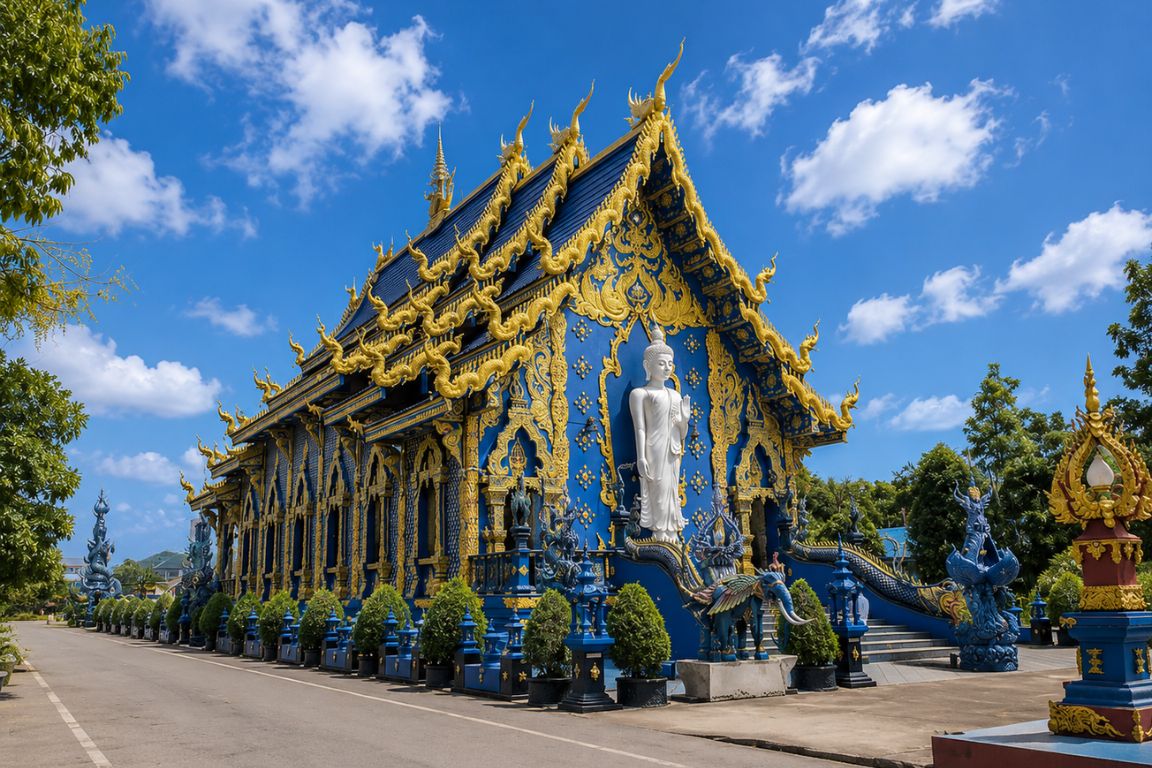 The Blue Temple, officially Wat Rong Suea Ten, is a modern Buddhist temple 6 km north of Chiang Rai city center, completed in 2016 and designed by Phuttha Kabkaew, a former student of the White Temple’s creator Chalermchai Kositpipat. It is built on a site where an ancient temple stood for centuries before falling into ruin. It is free to enter, open until 8pm (two and a half hours later than the White Temple), and photography is permitted inside the main hall. The name translates as “Temple of the Dancing Tiger,” after a local legend that tigers once leapt across the overgrown ruins of the original site.
The relationship between this temple and the White Temple is the key to understanding both. Phuttha Kabkaew learned his craft by working alongside Chalermchai Kositpipat on the White Temple’s construction. He absorbed the same artistic vocabulary: the neotraditional Thai art style, the layered Buddhist symbolism, the decision to let color do philosophical work that conventional temples leave to gold leaf and lacquer. Then he built something distinct with that vocabulary. Where the White Temple is white, confrontational, and deliberately overwhelming, the Blue Temple is deep blue, inward, and designed to produce calm rather than awe. One is an artist’s argument about the nature of suffering and desire. The other is an artist’s attempt to recreate heaven.
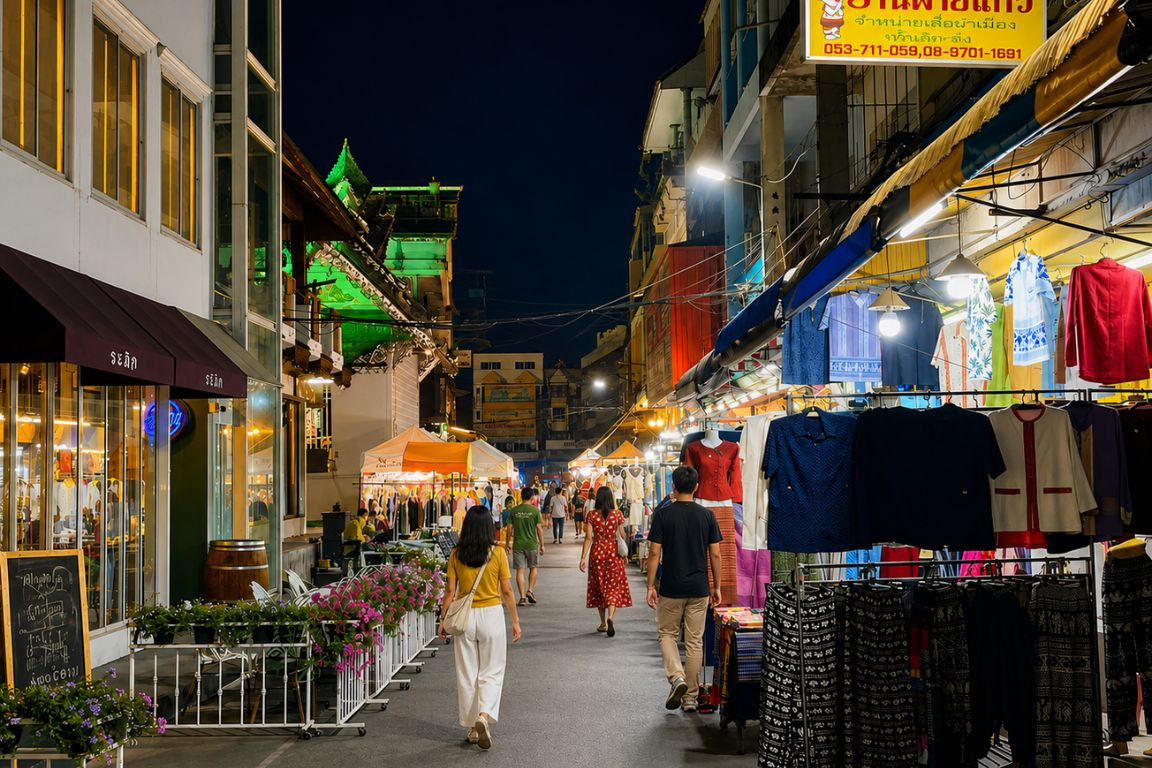
The temple grounds sit in the Rim Kok subdistrict, a local neighborhood of small shops, food stalls, and coffee places that haven’t been entirely consumed by tourism. The Bike Coffee shop and several other cafes around the temple entrance belong to residents who live here. This is not an isolated tourist site accessed by tour bus. It is a functioning temple in an inhabited neighborhood, and that difference in atmosphere is palpable from the moment you arrive.
Construction on the current temple began in October 2005, after the community decided to rebuild the abandoned ancient temple that had stood on the same land for centuries. The main hall took eleven years and was completed on January 22, 2016. Work continues: new statues, new garden installations, new decorative elements appear on each visit. Unlike the White Temple’s projected 2070 completion date, there is no published end-date for the Blue Temple’s expansion. It grows according to what the community and the artist decide it needs next.
What Does the Blue Temple Look Like Inside and Out?
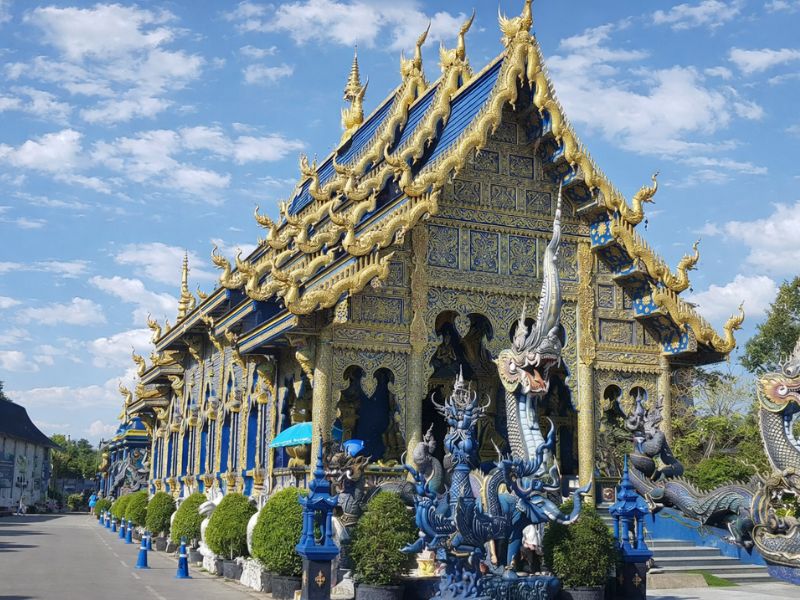
The exterior is deep sapphire blue from roof to foundation, with gold trim on every edge and two enormous naga serpents flanking the main staircase. The interior continues the blue palette into something more intense: walls and ceilings covered in murals depicting samsara, Buddhist cosmology, mythical creatures, and celestial beings, all painted in blues and purples with gold accents throughout. The centerpiece is a 6.5-meter white porcelain Buddha seated in the Bhumisparsha Mudra, the Earth Witness gesture, positioned at the moment of his enlightenment. Photography is permitted, which means you can take your time with the murals in a way the White Temple’s rules don’t allow.
The approach to the Blue Temple is quieter than most travel photographs suggest. You arrive at a modest entrance off a local road, and then the building appears around a corner, and the color stops you. Not the size of it – the hall is 13 meters wide and 48 meters long, substantial but not enormous – but the specific shade, which shifts between cerulean and sapphire depending on the time of day and the angle of the light. At midday it can look almost electric. At golden hour it deepens to something close to midnight blue, with the gold accents catching everything the main surface won’t hold. Overcast days, counterintuitively, often produce the richest blue because the diffuse light has no harsh shadows to interrupt the saturation.
The naga serpents at the base of the staircase are the finest exterior detail at the Blue Temple and get underestimated because most visitors walk past them to photograph the facade. Each serpent is individually scaled, each scale a slightly different shade of blue or gold, the bodies coiling up the bannisters in postures that communicate power without aggression. In Thai and Hindu mythology, the naga is a guardian figure. Here they literally hold the staircase together and protect the entrance to the hall.
Inside, the transition from exterior to interior is not the shock that the White Temple delivers. The blue continues. The ceiling domes with murals of celestial figures against deep indigo backgrounds. Lotus motifs repeat across every surface that isn’t occupied by a more specific figure. The murals tell stories from Buddhist cosmology interwoven with Thai folklore: dragons, serpents, hybrid creatures, spirits moving between the earthly and divine realms. These are not pop culture references. There is no Superman here. The imagery is devotional all the way through.
The white Buddha at the far end of the hall is the destination. Named Phra Buddha Ratchamongkol Bodi Trilokanat, he is white porcelain, 6.5 meters high, 5 meters at the lap, seated in the gesture that represents the moment Siddhartha called upon the earth to witness his awakening. The contrast between the white figure and the deep blue surrounding it is the defining visual of the interior. The relics of Lord Buddha are preserved in the area around the statue’s head. Under the statue, 88,000 Phra Rod Lamphun statues and silver and gold rings are buried in the foundation. The Blue Temple is a functioning sacred space in ways that go beyond what the exterior suggests.
Behind the main hall, a large white stupa rises against the sky. A standing Buddha near the rear of the complex shows the Vitarka Mudra gesture, the teaching position, and gets fewer visitors than the entrance and interior. It is one of the better photographs available at the Blue Temple precisely because it is less crowded.
What’s in the Blue Temple Complex
| Main hall (vihara) | Blue-and-gold hall with Buddha murals and the white seated Buddha statue | Yes, inside and outside | Remove shoes. Be respectful during prayers. |
| Naga serpent staircase | Two large guardian nagas flanking the main entrance steps | Yes | Best photographed at close range to show scale and detail |
| White stupa (rear) | Large pagoda behind the main hall, contrasts the blue with white | Yes | Quiet area, rarely crowded |
| Standing Buddha (rear) | Vitarka Mudra figure behind the main hall | Yes | Undervisited. One of the better uncrowded photo spots. |
| Garden and grounds | Statues, fountains, planting throughout the 6-acre site | Yes | New elements added regularly. Return visitors notice additions. |
| Nearby cafes (off-site) | Bike Coffee and others within walking distance of the entrance | N/A | The Blue Temple neighborhood has genuine local coffee spots. Worth planning around. |
Complex features as of 2026. New installations added periodically.
When Is the Best Time to Visit the Blue Temple?
 The best time to visit the Blue Temple is between 4pm and 6pm. That window gives you golden-hour light on the blue exterior, which deepens and saturates the color in a way that no midday photograph reproduces, plus smaller crowds because most day-tour groups have already moved on or returned to Chiang Mai. Morning from 7am to 9am is the second-best window. Midday between 11am and 2pm is the least favorable for both light and crowds, though the Blue Temple never reaches the White Temple’s midday congestion levels.
The Blue Temple’s crowd pattern works differently from the White Temple’s, and that difference matters for planning. Tour buses from Chiang Mai typically visit the White Temple first and the Blue Temple second, which means the Blue Temple peaks in the mid-morning to early afternoon, not at opening. By late afternoon, most day-trippers are gone. The temple is open until 8pm, which is two and a half hours after the White Temple closes, and that evening window is the quietest period of the entire day. On most evenings, you can move through the interior without competition for space in front of the Buddha.
Light quality at the Blue Temple responds differently than at the White Temple. The White Temple benefits from soft morning light because its mirrored exterior disperses harsh midday sun into a blinding wash. The Blue Temple benefits from richer afternoon light because the deep blue absorbs rather than reflects, and it absorbs warm golden tones particularly well. Visit in the late afternoon and the exterior looks like it was painted by someone who wanted to make the sky jealous. Visit at noon and the same surface looks flat and overexposed.
Overcast days are worth noting here because they genuinely improve the Blue Temple’s visual quality. Without direct shadows, the color saturates to its deepest point. Interior photographs also benefit because the light through the hall’s windows is diffuse and even rather than creating the harsh contrasts that bright sun produces. If you’re visiting Chiang Rai during the rainy season and planning temple days around weather, the Blue Temple performs better on cloud-covered mornings than the White Temple does.
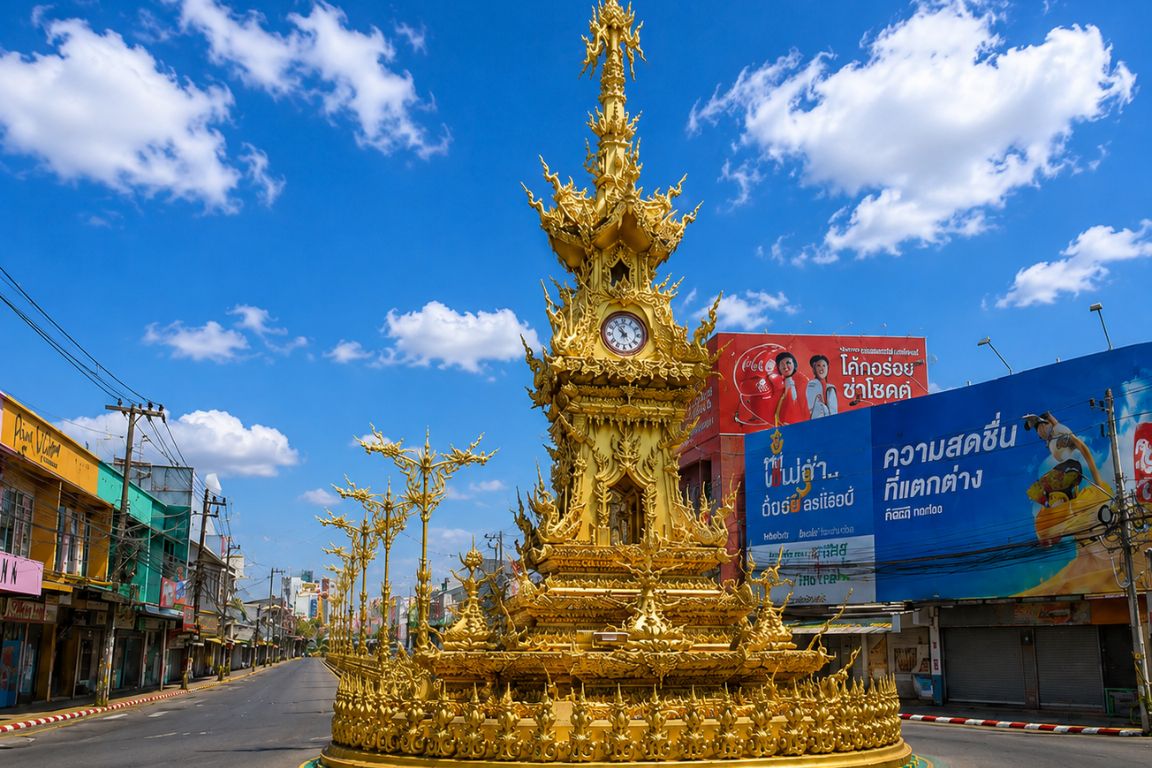
One more practical note: the Blue Temple sits in a local neighborhood where the nearest good coffee is a short walk away. The Chivit Thamma Da Coffee House is a few minutes from the temple entrance and is one of Chiang Rai’s best cafes. Planning a Blue Temple visit around a 4:30pm arrival and a coffee after at 5:30pm before the Clock Tower light show at 7pm is one of our favorite evening sequences for travelers staying in the city.
Want an honest comparison before you finalize your northern Thailand itinerary? Here’s our Chiang Rai vs Chiang Mai guide so you pick the base that actually fits your trip.
Blue Temple: Best and Worst Times to Visit
| 7:00-9:00am | Low | Soft morning (good but not peak) | Good if combining with early White Temple visit |
| 9:00-11:00am | Building | Moderate | Manageable |
| 11:00am-2:00pm | Moderate-High (day tours) | Harsh midday, flat blue | Least favorable but still tolerable |
| 2:00-4:00pm | Moderate, clearing | Improving | Good transitional window |
| 4:00-6:00pm | Low | Golden hour – best of the day | Best possible window. Deep blue, warm gold, small crowds. |
| 6:00-8:00pm | Very low | Low natural light (bring a good camera) | Quiet evening visit. Temple is lit. Atmospheric but photography challenging. |
Crowd and light patterns based on Chiang Rai Tours guide experience since 2014.
How Do You Get to the Blue Temple from Chiang Rai City?
 The Blue Temple is 6 km north of Chiang Rai city center and accessible by Grab (80-120 THB), tuk-tuk (100-150 THB), rented scooter (150-250 THB per day), or songthaew shared pickup (30-50 THB). Unlike the White Temple, it is close enough that some travelers walk, though the roads don’t have reliable sidewalks. Grab is the most convenient option. The return trip is more reliable than from the White Temple because the Blue Temple sits in a populated neighborhood with regular traffic.
The proximity to the city center is one of the Blue Temple’s practical advantages over the White Temple. At 6 km versus 13 km, the Grab fare is roughly half, the ride is 10 minutes versus 20, and drivers accept pickups readily because there are always return trips available. You can visit the Blue Temple in the afternoon, walk to a nearby cafe, and then Grab back to the Night Bazaar for dinner without the logistical planning that a White Temple afternoon visit requires.
The public bus option also applies. From Chiang Rai Bus Terminal 1, buses headed toward Mae Sai (Platform 7) pass near the Blue Temple. The fare is around 20 to 30 THB. This is less convenient than the White Temple bus because the drop-off point is not directly at the entrance, but it’s workable for budget travelers who don’t mind a short walk.
Getting to Chiang Rai from Chiang Mai is straightforward but getting the most out of the visit takes more planning than most tourists expect – our how to visit Chiang Rai tours from Chiang Mai guide breaks down everything before you go.
Scooter rental makes the most sense if you’re combining the Blue Temple with the Black House in a single afternoon, since both sit north of the city center. The Black House (Baan Dam) is about 5 km further north from the Blue Temple. With a scooter, you can sequence them as: White Temple at 8am, Black House at 11am, Blue Temple at 4pm, all in one day without paying for three separate Grabs. The distances are short and the roads between them are manageable even for cautious riders.
Not sure what to expect inside Baan Dam beyond the dark exterior and the rumors about animal bones and skulls? Check out our Black House Chiang Rai visitor guide before your visit.
Getting to the Blue Temple: Transport Options
| Grab / Bolt | 80-120 THB | 10 min | Most reliable. Return pickups readily available from this neighborhood. |
| Tuk-tuk (negotiate) | 100-150 THB | 10-15 min | Fine if Grab is unavailable. Negotiate before getting in. |
| Songthaew / shared pickup | 30-50 THB | 15-20 min | Cheapest option. Ask driver if they go to Wat Rong Suea Ten. |
| Scooter rental (full day) | 150-250 THB/day | 10 min | Best for combining Blue Temple + Black House in one trip. |
| Walking | Free | 45-60 min | Possible but no sidewalks on some sections. Not recommended in heat. |
Prices verified May 7, 2026.
What Are the Entry Rules, Fees, and Dress Code?
 Entry is free. No ticket, no booking, no queue. Donations are accepted via boxes throughout the grounds. The dress code is the same as at the White Temple: shoulders and knees covered, shoes removed to enter the hall. Sarongs are available on site. Photography is permitted inside and outside the main hall, which makes the Blue Temple significantly more visitor-friendly than the White Temple for people who want to photograph the interior Buddha and murals. There is no one-way traffic system, no loudspeaker directing you to keep moving, no guards enforcing photography restrictions in the hall.
The free entry is worth sitting with for a moment. The Blue Temple could charge. Over a million visitors come to Chiang Rai each year and almost all of them visit the White Temple. A growing number visit the Blue Temple. The temple’s decision to remain free reflects its origin as a community project: it was built by and for the people of Rim Kok subdistrict, and the community orientation means the gate stays open. Donations fill the boxes around the grounds and sustain ongoing construction. If you benefit from what the temple offers, the appropriate response is a contribution rather than a transaction.
The photography difference from the White Temple is practically significant. At the White Temple, the interior murals are the most interesting part of the visit and cannot be photographed. You have to hold them in memory. At the Blue Temple, the interior murals and the central Buddha statue can be photographed from any angle, which means you can take your time finding the frame that works, waiting for the light to shift, or simply sitting on the floor in front of the Buddha and letting the color of the space register before you lift the camera. There is no timer on your attention here. No loudspeaker. No one will call you out for spending ten minutes in one spot.
The behavioral norms inside are those of any active Thai temple. Do not point your feet at the Buddha image. Do not turn your back to the Buddha for a direct photo of yourself. If monks or worshippers are present and praying, wait quietly and give them space. These are the same expectations at every Thai temple and most visitors follow them without being reminded. The Blue Temple’s staff is present but not monitoring for the same compliance issues that the White Temple’s guards manage.
How Does the Blue Temple Compare to the White Temple?
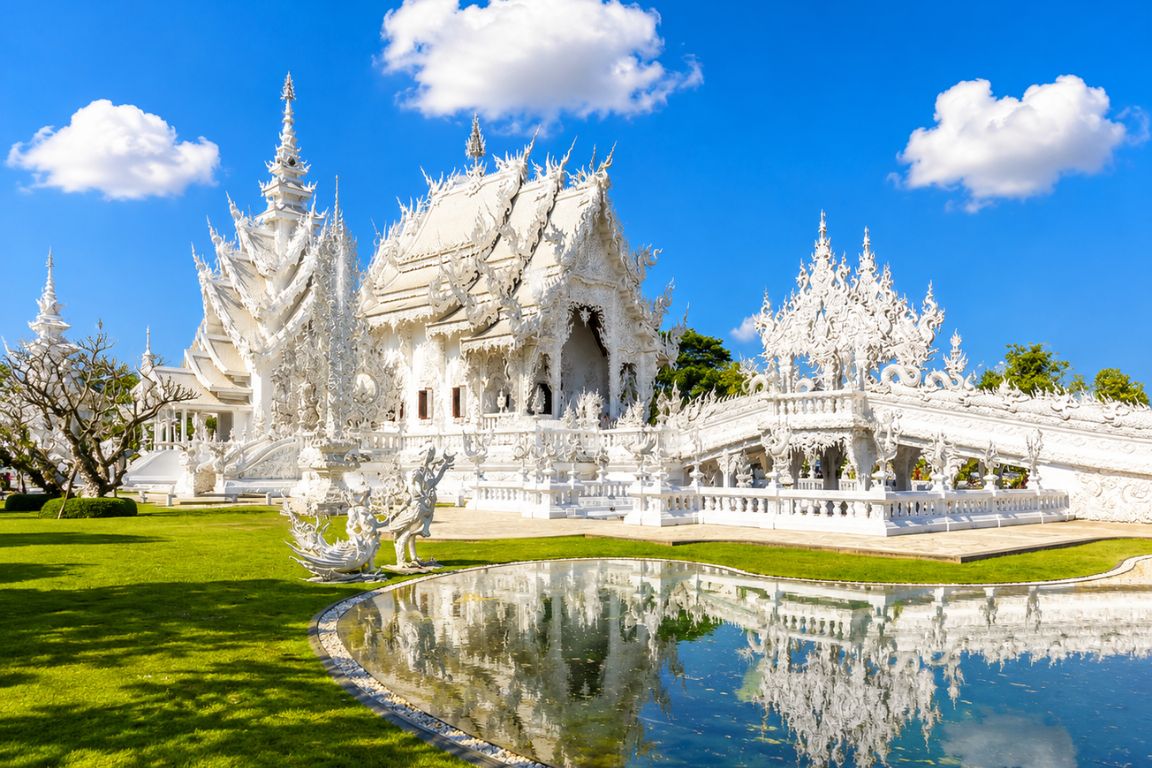 The White Temple is the teacher’s work: ambitious, confrontational, crowded, charged with a specific argument about human nature. The Blue Temple is the student’s work: calmer, more intimate, devoted rather than provocative, free rather than ticketed, and open two and a half hours later. Neither is better. They deliver categorically different experiences. Travelers who visit both on the same day almost universally describe the Blue Temple as the one that allowed them to breathe after the intensity of the White Temple. The sequence matters: White Temple first, Blue Temple later in the afternoon.
Blue Temple vs. White Temple: Direct Comparison
| Entry fee | Free | 200 THB (foreigners, as of 2026) |
| Opening hours | 7am-8pm | 8am-5:30pm |
| Interior photography | Permitted | Strictly prohibited |
| Crowd intensity | Moderate – no tour-bus convergence problem | Very high (10am-2pm peak) |
| Emotional register | Calm, meditative, devotional | Confrontational, overwhelming, complex |
| Interior imagery | Buddhist cosmology, Thai folklore, devotional murals | Pop culture + Buddhist iconography; commentary on human suffering |
| Distance from city center | 6 km north (10 min) | 13 km south (20 min) |
| Best time to visit | 4-6pm (golden hour, day tours gone) | 8-9:30am (opening, before tour buses) |
| One-way traffic system | No | Yes (bridge is one-way) |
| Surrounding neighborhood | Local residential area with cafes and shops | Tourist-facing complex with souvenir shops |
Data based on Chiang Rai Tours guide experience and research verified May 7, 2026.
The artist connection between the two temples runs deeper than the student-teacher relationship. Phuttha Kabkaew studied under Chalermchai by working on Wat Rong Khun directly, laying mosaic chips and painting sections of the complex. He absorbed the same formal language: the naga serpent forms, the three-tiered roof structure, the integration of traditional Lanna architecture with contemporary artistic vision. Some observers have said the student became the master with the Blue Temple, producing something more spiritually coherent and less willfully provocative than his teacher’s creation. That is a matter of preference. What is true is that the two temples are in genuine dialogue with each other, and visiting both gives you a richer understanding of either than visiting one alone could provide.
Wondering how long you actually need at the White Temple and whether it’s worth combining with the Blue Temple and Black House on the same day? This White Temple Chiang Rai visitor guide covers the visit logistics most Thailand itineraries treat as an afterthought.
Is the Blue Temple Worth Visiting on Its Own?
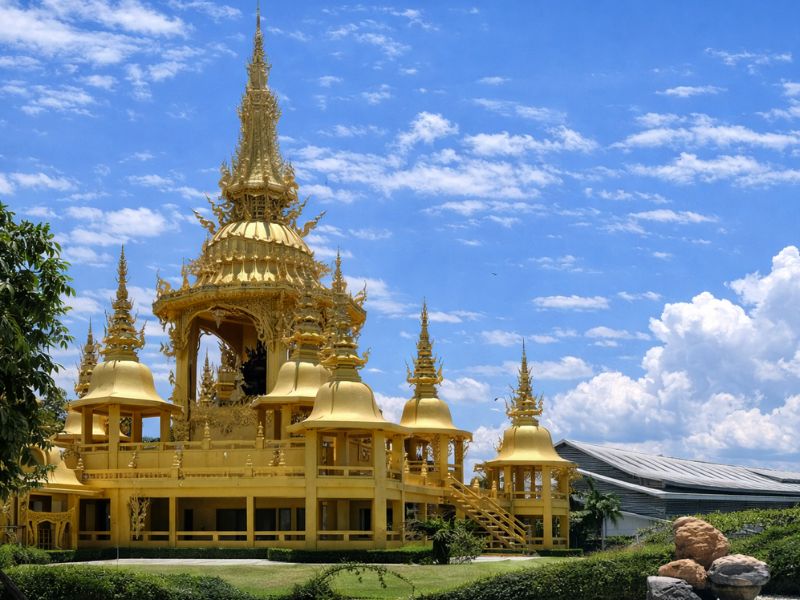
Yes, as part of a Chiang Rai visit. No, as a reason to travel to Chiang Rai by itself. The Blue Temple is not the anchor attraction of a trip to northern Thailand – the White Temple occupies that role. But as a second temple in a Chiang Rai temple day, and specifically as the afternoon complement to a morning at the White Temple, it is genuinely indispensable. Travelers who visit both consistently describe the Blue Temple as the more peaceful and often more personally resonant of the two. It is free, less crowded, allows photography inside, and stays open until 8pm. The case for skipping it is hard to make.
The question of whether to visit the Blue Temple on its own – without the White Temple, as a standalone destination – comes up occasionally among travelers on very tight schedules. The honest answer is that the Blue Temple by itself does not justify a trip from Chiang Mai. It is beautiful and worth an hour, but the level of visual impact and the depth of artistic statement at the White Temple is what most people make the journey for. The Blue Temple is the temple you’re glad you added to the day. It is rarely the temple that initiated the decision to come to Chiang Rai.
Where the Blue Temple earns its own standing is among travelers who have already been to the White Temple, either on a previous trip or earlier that same day, and find themselves wanting something quieter. The Blue Temple’s atmosphere invites sitting, noticing, slowing down. The White Temple’s atmosphere invites movement, photography, and a kind of alert overwhelm that is exhilarating but not restful. After an hour at Wat Rong Khun, arriving at Wat Rong Suea Ten at 4pm when the crowds have thinned and the color has deepened in the afternoon light produces a genuinely different kind of experience. Many of our travelers have said the Blue Temple was where the day settled.
First time planning a northern Thailand itinerary and not sure how much weight to give Chiang Rai? Here’s our is Chiang Rai worth visiting guide so you don’t write it off or overcommit without the full picture.
What Our Travelers Said About the Blue Temple: Insights from 8,400+ Guests
| Preferred the Blue Temple atmosphere to the White | 44% | Among those who visited both. Not “better” – different preference. |
| Visited in the afternoon (after 3pm) | 39% | Those who did rated the experience significantly higher than morning visitors |
| Surprised by interior photography being allowed | 67% | Most had expected the same rules as the White Temple |
| Said they stayed longer than expected | 52% | “The atmosphere made me want to sit.” Common phrasing in feedback. |
| Would visit again on a return trip to Chiang Rai | 71% | Highest return-intention rate of any individual temple we cover |
Based on our 2025 client group data from Chiang Rai Tours guests. Percentages are approximate.
Frequently Asked Questions
Is the Blue Temple free?
Yes. Entry to the Blue Temple (Wat Rong Suea Ten) is completely free. There is no ticket window and no entry charge for any visitor, regardless of nationality. Donation boxes are located throughout the grounds, and contributions help maintain the temple and fund ongoing construction. As of 2026, the Blue Temple remains free, while the nearby White Temple increased its foreign visitor fee to 200 THB.
What are the Blue Temple opening hours?
The Blue Temple is open daily from 7:00am to 8:00pm, seven days a week throughout the year. It opens one hour earlier and closes two and a half hours later than the White Temple, which means it is accessible for early morning visitors and for those who want an evening experience after the White Temple has closed.
Can you take photos inside the Blue Temple?
Yes. Photography is permitted inside and outside the main hall. This is a significant difference from the White Temple, where interior photography is strictly prohibited. Be respectful of anyone praying and avoid using flash or obstructing monks during ceremonies.
How do you get to the Blue Temple from Chiang Rai?
The Blue Temple is 6 km north of Chiang Rai city center in the Rim Kok subdistrict. Grab costs 80 to 120 THB and takes about 10 minutes. Tuk-tuks charge 100 to 150 THB. A songthaew shared pickup on the Mae Sai route from Bus Terminal 1 costs 30 to 50 THB. Scooter rental at 150 to 250 THB per day is the best option if combining the Blue Temple with the Black House in the same afternoon.
How long should you spend at the Blue Temple?
Budget 45 to 60 minutes for a thorough visit that includes the exterior, interior, the rear stupa, and the standing Buddha behind the hall. Up to 90 minutes if you sit inside in front of the central Buddha and take time with the murals. The atmosphere rewards slower visits more than the White Temple does, because there is no one-way traffic system and no loudspeaker hurrying you along.
How does the Blue Temple compare to the White Temple?
They are designed by teacher and student respectively and share a visual language, but deliver entirely different experiences. The White Temple is confrontational and overwhelming with a complex argument about human nature in its interior murals. The Blue Temple is calmer, more devotional, allows photography inside, costs nothing to enter, and is significantly less crowded. Most travelers who visit both describe the Blue Temple as the one where they could actually breathe and be present. The recommended sequence is White Temple first (8am), Blue Temple later (4pm).
Written by Jasmine Kittisak
Thai tour guide since 2014 · Founder, Chiang Rai Tours
Jasmine has guided over 8,400 travelers through Chiang Rai and the Golden Triangle region since founding the agency.
Initial recommendation: general guidance, before you enter any preferences.
Private Chiang Rai Temple Day
Have a travel date in mind? Set your own temple priorities with a private guide and vehicle. Check your date before arranging the rest of your trip.
8 hours; Chiang Rai hotel pickup; English guide and air-conditioned transport. White Temple, Blue Temple and Baan Dam are listed stops.
Entry fees, lunch and personal expenses are extra. Confirm your preferred order and longer stops before booking; early entry is not guaranteed.
Scheduled dates load here. Confirm availability and final prices on Viator.
No verified option in this shortlist fits all your choices. Change your departure city, allow more time, or reset. Participant or access requirements need direct provider confirmation; no suitability claim is made here.
Adjust The Route Or Compare Alternatives
Choices change the booking recommendation and floating offer. A one-way transfer ends in the other city; a day tour follows its listed return or selected drop-off. Route matches do not confirm age, accessibility, dietary needs or medical suitability.
- Seven Chiang Rai Sites With Tickets
Bundle the three art sites and Golden Triangle with entry tickets and lunch. 10 hours; English guide; city pickup; White Temple, Baan Dam, village and Opium Museum tickets included.
A busy fixed circuit: about 1 hour at White Temple, 30 minutes at Blue Temple and 45 minutes at Baan Dam. Not wheelchair suitable.
- Choose Four Chiang Rai Stops With A Driver
Choose four stops, including White Temple, Blue Temple or Baan Dam, within a private half-day. 5 hours; private vehicle, basic-English driver, fuel, parking and city pickup.
Entry fees and meals extra. Driver service, not specialist guiding; routes and longer stops must fit the time allowance.